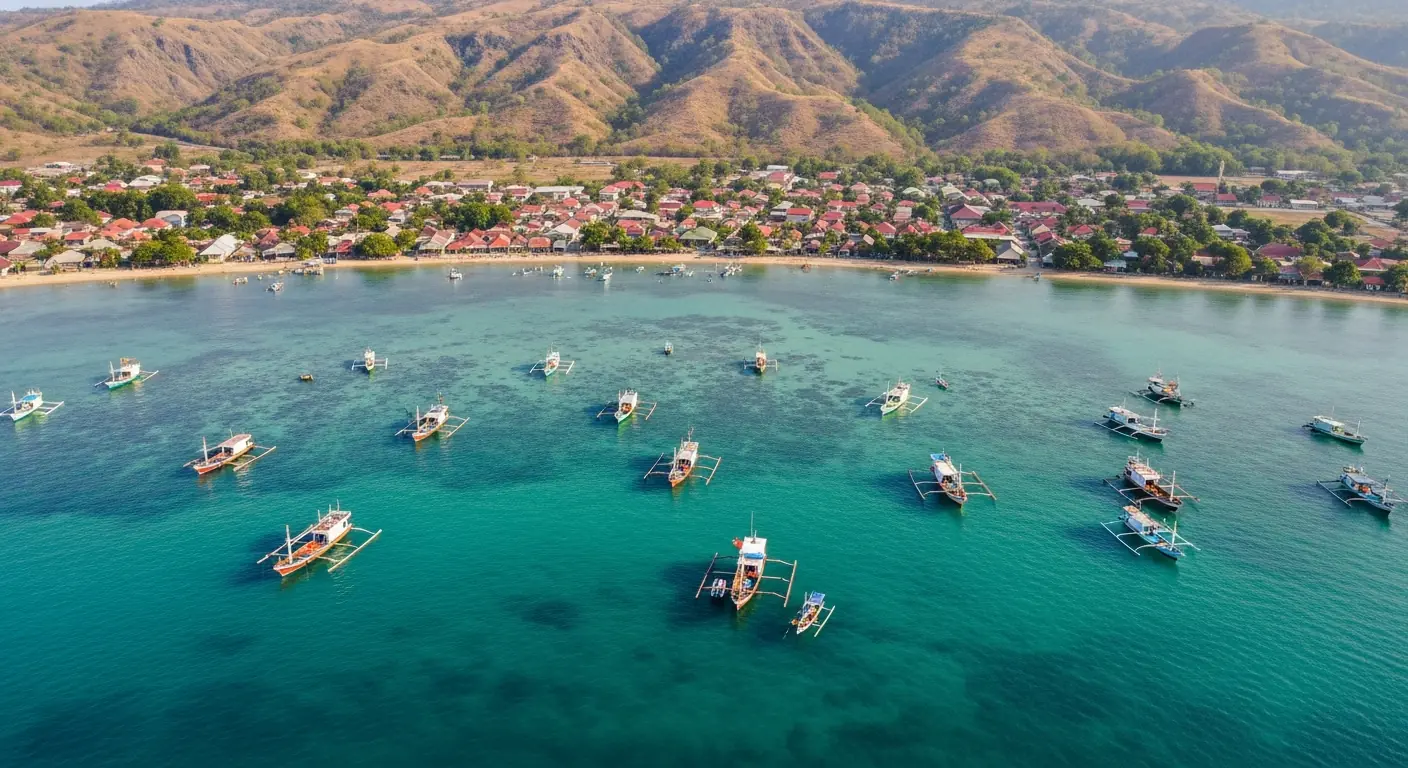
The dry season air carries the scent of salt and dust across Kupang Bay. Ferries arrive and depart from Bolok, their horns echoing over the water. Motorbikes weave through streets where colonial-era architecture stands alongside modern developments. This is Kupang, a city of transit and a hub for exploration, where the rhythms of East Nusa Tenggara converge.
Kupang: Gateway to East Nusa Tenggara
Kupang functions as the administrative and economic heart of East Nusa Tenggara, serving as the capital of the Indonesian province. Its strategic location makes it a critical nexus for regional travel and commerce. The city’s population was recorded at 442,758 residents during the 2020 Census. This figure reflects its growth as a regional center. The official mid-2024 population estimate for Kupang stands at 474,801 residents, indicating a steady increase in urban density and activity. Geographically, Kupang is situated at approximately 10.170167°S latitude and 123.607750°E longitude, placing it on the southwestern coast of Timor Island. From this vantage point, travelers access not only the interior of West Timor but also the surrounding islands. The city’s role as a transit point is central to its identity, facilitating movement for both local inhabitants and international visitors. This urban environment, while not a primary destination for many, offers essential services and connections.
City Attractions and Local Life
Within Kupang, several sites provide insight into the city’s character. The Pasir Panjang Beach, located close to the city center, offers sunset views over the strait. Kupang’s traditional market, Pasar Inpres, operates daily, providing a cross-section of local produce, spices, and craft items. Here, transactions occur in Indonesian Rupiah, with prices varying based on seasonality and negotiation. The Museum Negeri Provinsi Nusa Tenggara Timur houses artifacts related to the region’s ethnography and history. Entry fees are typically nominal, often less than 10,000 IDR. For a broader perspective on the city’s development, the area around the Governor’s Office showcases significant public architecture. Local eateries, known as *warungs*, serve regional specialties such as *se’i* (smoked meat) and fresh seafood, typically for 20,000-50,000 IDR per meal. These establishments operate throughout the day, with peak hours during lunch and dinner.
El Tari International Airport (KOE): Air Access
El Tari International Airport (KOE) is the primary air gateway to West Timor and the broader East Nusa Tenggara region. The airport operates with the IATA code KOE and the ICAO code WATT. It handles a significant volume of domestic traffic, connecting Kupang to major Indonesian cities. Daily flights operate to destinations such as Jakarta, Surabaya, and Bali. These routes are serviced by several Indonesian carriers, including Garuda Indonesia, Lion Air, and Citilink. Flight durations vary; for instance, a direct flight to Jakarta typically takes approximately 2 hours and 30 minutes. The airport facilities include a single terminal building, currency exchange services, and various food and beverage outlets. Taxi services and ride-sharing apps are available for transport from the airport to central Kupang, with fares ranging from 80,000 to 150,000 IDR for a 20-30 minute journey, depending on traffic. Travelers use KOE as a crucial entry and exit point for their journeys across the archipelago. El Tari International Airport provides essential connectivity for both tourism and business.
Overland Travel in West Timor
Travel beyond Kupang into the interior of West Timor involves a network of roads and public transport. Buses and shared taxis (known as *travel*) connect Kupang to towns such as Soe, Kefamenanu, and Atambua. A journey to Soe, approximately 110 kilometers east, takes around 3-4 hours, with fares typically between 50,000 and 70,000 IDR. The roads, while generally paved, can be winding and experience varied conditions, especially during the wet season from November to April. Scenic routes offer views of traditional Timorese villages and agricultural landscapes. Hiring a private car with a driver is an option for greater flexibility, costing around 600,000 to 1,000,000 IDR per day, depending on the itinerary and distance. Destinations like Oenesu Beach, 15 kilometers south of Kupang, are accessible via motorbike or private car. This allows for exploration of coastal areas beyond the immediate city limits. The landscape transitions from coastal plains to rolling hills, revealing distinct cultural regions.
Ferry Routes and Island Connections
Kupang serves as a critical hub for inter-island ferry services, connecting West Timor to other parts of East Nusa Tenggara and neighboring Timor-Leste. The Pelni (national ferry company) terminal and local ferry docks are located at Bolok, approximately 20 kilometers west of central Kupang. Regular ferry services operate to Rote Island, a popular destination for surfing and diving, with journeys taking approximately 2-3 hours for fast ferries and 4-5 hours for slower public ferries. Fares for Rote range from 70,000 to 150,000 IDR. Another significant route connects Kupang to Dili, the capital of Timor-Leste. These international ferry services are less frequent, often operating once or twice a week, and require passport and visa considerations for non-Indonesian and non-Timorese citizens. The journey duration to Dili can be up to 12 hours. Additionally, smaller boats and local ferries connect Kupang to Semau Island, which is a short 30-minute to 1-hour trip, costing around 20,000-30,000 IDR. These routes are essential for both local commerce and for travelers seeking to explore the diverse islands of the region. Kupang is a vital maritime gateway.
Kupang Local Transport and Trip Planning
Navigating Kupang itself involves a range of local transport options. *Bemos* (minibuses) operate on fixed routes throughout the city, providing an economical way to travel. Fares for a *bemo* ride within the city are typically 3,000-5,000 IDR. Taxis are available, though less common than *bemos* or ride-sharing services. Online ride-sharing apps like Grab and Gojek are widely used for motorbikes (*ojek*) and cars, offering convenient on-demand transport with transparent pricing. A typical Grab ride from the city center to a nearby beach might cost 15,000-30,000 IDR. Renting a motorbike is another popular option for independent travelers, with daily rates ranging from 70,000 to 120,000 IDR. This allows for flexibility in exploring both the city and its immediate surroundings. When planning a trip, considering the dry season (May to October) is advisable for optimal travel conditions, particularly for island hopping and overland journeys. Accommodation options in Kupang range from budget guesthouses starting at 150,000 IDR per night to mid-range hotels at 400,000-800,000 IDR per night. Kupang provides a base for extensive regional exploration.
For detailed itineraries, transport schedules, and in-depth guides to the beaches and islands of East Nusa Tenggara, explore more at Kupang Travel.